Research data management (RDM) has become an increasingly important part of modern research. Yet a fundamental question remains: What does good research data management actually look like in practice? How should data be structured, documented, protected, and tracked? Which software tools can automate these processes? And how can good RDM reduce manual work, prevent costly errors, and facilitate the reuse of research data for future studies, data integration, and AI applications?
Course Details
| Language | English |
| Duration | 4 weeks |
| Effort | 1 hr/wk |
Description
In this course, we address these questions by connecting RDM principles with practical implementation. We introduce the theoretical foundations of research data management, demonstrate how software tools can support and automate data management workflows, and show how these concepts are implemented in a real-world biomedical research project at NEXUS.
The course goes beyond theory. Practical examples are complemented by open-source code and access to a hosted demo server, allowing participants to explore the implemented data structures and workflows and see how they work in practice.
Goal of the Course
The goal of this course is to provide researchers and data professionals with the theoretical foundation and practical tools needed to design and implement effective research data management workflows. Participants should be able to transfer the presented concepts and approaches to their own research projects and develop data workflows that are efficient, secure, traceable, reproducible, and suitable for future reuse.
Upon completion, participants will be able to:
- explain why structured data management is a prerequisite for traceable and reusable biomedical research data,
- describe how NEXUS organizes data management across a project lifecycle, and
- assess how a platform such as LabKey Server can be configured to implement these requirements in practice.
The course is organized into four modules:
Module 1: Research Data Management (RDM) Fundamentals
- Explain what RDM covers and why it is critical for complex and sensitive biomedical data
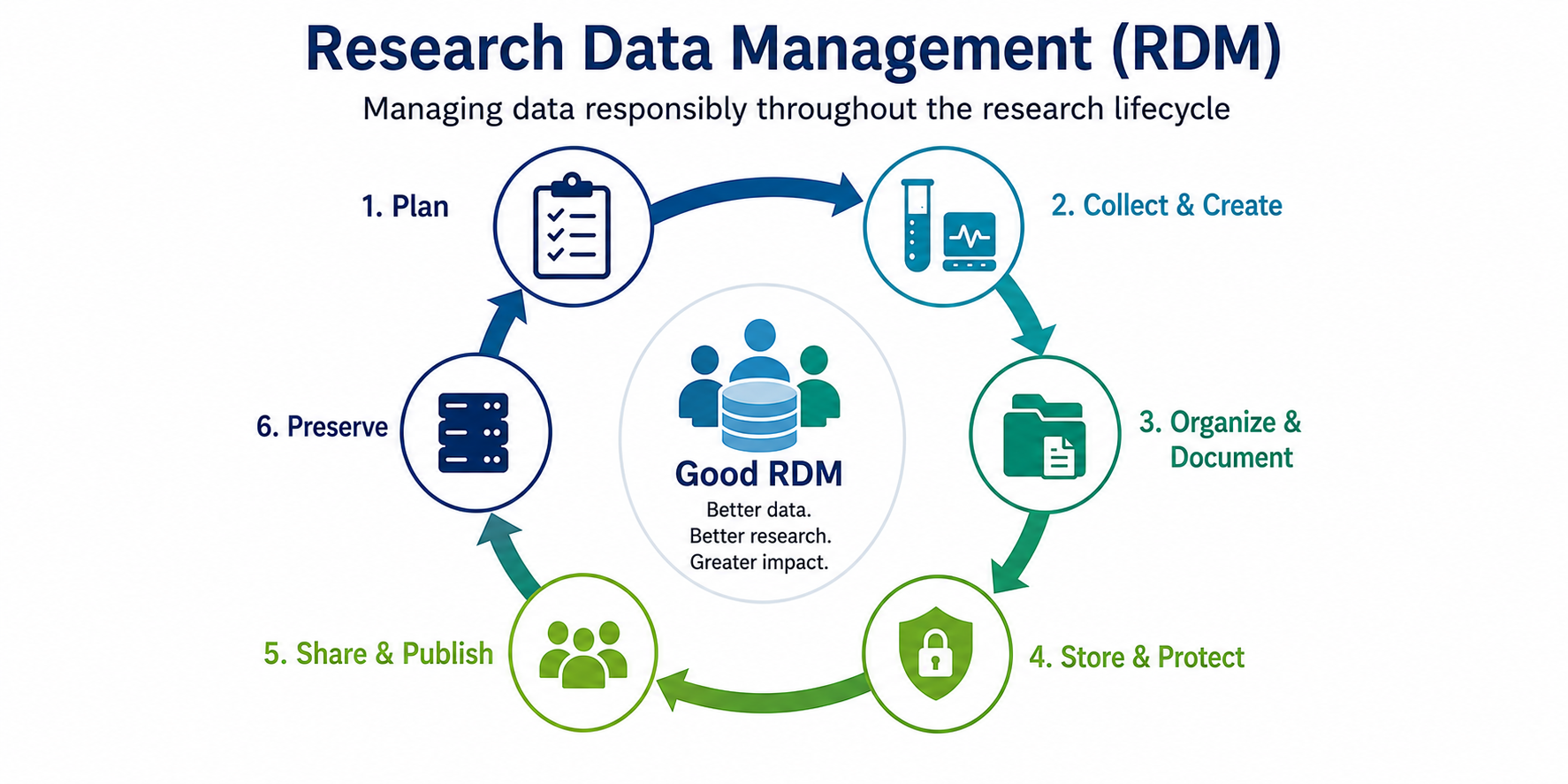
- Describe the ten fundamental concepts of RDM, from planning to long-term preservation
- Locate research data along the seven stages of the research data lifecycle and name the typical RDM activities in each stage
- Explain how the FAIR principles relate to everyday data management decisions
- Distinguish data management from data engineering and describe how the two depend on each other
Module 2: RDM at NEXUS
- Describe the four building blocks of project data management at NEXUS: access management, documentation, tracking, and data repository
- Explain why structured onboarding and role-based access control are essential when handling identifiable and patient-related data
- Distinguish the three layers of project documentation: online guidance, SOPs in LabKey Server, and version-controlled technical documentation
- Outline how participants, samples, experiments, and analysis data are connected to form one traceable path
- Follow the NEXUS data repository workflow on secure infrastructure, from data drop to validated repository
- Justify why spreadsheets should not serve as the primary system of record and name suitable alternatives
Module 3: LabKey as the implementation platform
- Explain the purpose, scope, and editions of LabKey Server, and why it is a configurable platform rather than a fixed application
- Describe the core components: projects, folders, datasets, sample types, data classes, queries, reports, and modules
- Explain how a LabKey deployment is set up technically, including database, file storage, and custom modules
- Configure the user interface conceptually using web parts and dashboards tailored to a role or workflow
- Assign permissions correctly using LabKey users, groups, and roles, and assess the limits of the default audit log
- Explain how LabKey supports metadata quality, traceability, and controlled data sharing
Module 4: Real-world sample management
- Design an identifier model for participants, samples, processing steps, and data files that is unique, permanent, and free of personal information
- Explain why the identifier structure must be defined before data collection starts
- Model a study in LabKey Server using participant datasets, sample types, derived samples, and data classes
- Apply controlled vocabularies to enforce consistent metadata at the point of entry
- Assess how custom web forms automate registration, file upload, and visualization, and where automation pays off
- Compare a flat spreadsheet approach with a lineage-based data model and explain the resulting gain in traceability and reusability
- Transfer the design principles of the mTORUS implementation to other biomedical studies and technologies
Legal Notice
Authorship
- Dr. Natalia Chicherova (Senior Data Steward at NEXUS Personalized Health Technologies)
- Immo Wille (ETH Library, Information Literacy Hub)
Contributors
- Dr. Julian Dederke (ETH Library, Research data management and digital curation)
- Boris Simic (Full-Stack Software/Data Engineer at NEXUS Personalized Health Technologies)
Image Sources and Rights:
Unless otherwise stated, the images, graphics, and screenshots used in this course are from NEXUS and are copyrighted. © NEXUS, 2026. All rights reserved. Some illustrations were created with the support of generative AI; the selection, editing, and integration were done by NEXUS.
Video Sources and Rights:
- LabKey. (2016, 21. Juli). LabKey Server Overview Video [Video]. YouTube. https://www.youtube.com/watch?v=zxJ2iN-QjcU
Embedded via the official YouTube player.